
MOLE, SKIN TAG AND WART REMOVAL IN ABU DHABI
$
Mole, Skin Tag and Wart Removal in Abu Dhabi
Mole removal in Abu Dhabi at House of Skincare begins with a medical assessment of the lesion, not a cosmetic treatment decision. Any pigmented lesion or growth on the skin, whether it is a mole, skin tag, wart, seborrheic keratosis, or dermatofibroma, requires clinical assessment before removal is appropriate. At House of Skincare on Yas Island, Dr. Khadija Al Zaabi, DOH-licensed Consultant Dermatologist with over 21 years of clinical experience, examines every lesion with dermoscopy before recommending removal and before choosing the most appropriate removal method. This is not a precaution. It is the standard of care. Removing a lesion that requires histological examination without sending it to pathology misses a diagnostic opportunity that can be clinically significant.
The vast majority of lesions removed at House of Skincare are benign and require removal purely for cosmetic or functional reasons. But the assessment comes first. Dermoscopy allows Dr. Al Zaabi to identify features of lesions that require surgical excision and histopathology, which is the subset of lesions where clinical judgement determines whether a cosmetic treatment is appropriate or whether the lesion needs a different approach. This clinical rigour is what distinguishes dermatologist-led removal from non-medical skin clinics.
Why House of Skincare for Mole and Skin Lesion Removal?
Every lesion at House of Skincare is examined by Dr. Al Zaabi with a dermoscope before any removal is performed. Features such as irregular border, asymmetry, variegated colour, or specific dermoscopic patterns indicating atypical architecture are evaluated before the removal method is selected. If any feature raises clinical concern, excision with histopathology is recommended rather than non-excisional removal. This is not an overreaction. It is the appropriate medical response to a dermoscopic finding that warrants further investigation.
For lesions confirmed as benign, the removal method is chosen based on the type of lesion, its depth, its location on the body, and the patient’s skin tone and healing pattern. A single method does not suit all lesion types. Dr. Al Zaabi selects the appropriate technique at your assessment.
House of Skincare holds a 4.9-star patient rating. The clinic is DOH-licensed. Lesion removal is a clinical procedure that should always begin with a qualified physician examining the lesion.
Types of Lesions Treated at House of Skincare
Melanocytic naevi (moles): Benign, pigmented lesions composed of melanocytes. These may be flat or raised, smooth or rough, and range in colour from light tan to dark brown or black. Most are benign throughout life. Features that suggest atypical change and warrant further assessment include asymmetry, irregular border, uneven or multiple colours, diameter over 6mm, and change over time. Dr. Al Zaabi assesses all of these at dermoscopy. Benign moles confirmed as suitable for cosmetic removal are treated with shave excision or electrocautery, leaving a flat scar that typically fades to near invisible in non-keloid-prone skin.
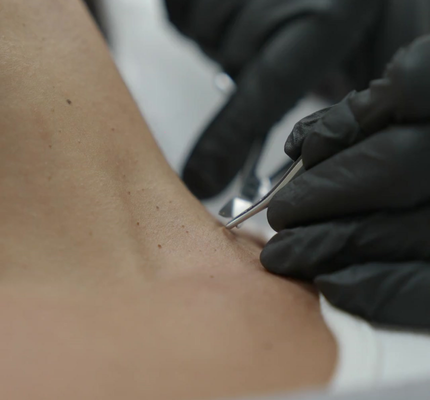
Skin tags (acrochordon): Soft, pedunculated flesh-coloured growths that appear most commonly on the neck, axillae, eyelids, and inframammary areas. Skin tags are entirely benign, caused by skin friction, and have no malignant potential. They are removed for cosmetic reasons or because they catch on clothing or jewellery. Removal at House of Skincare uses electrocautery or, for very small tags, cryotherapy. Multiple skin tags can be treated in a single session.
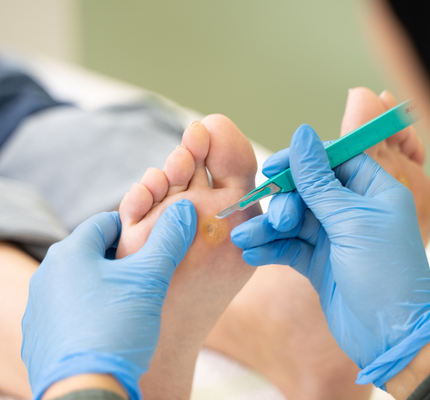
Warts (verrucae): Warts are benign epidermal lesions caused by human papillomavirus (HPV). They appear as rough-surfaced, keratotic papules on the hands, feet, face, and other areas. Plantar warts on the sole of the foot can be painful. Common warts on the hands and periungual area are a source of cosmetic concern and can spread by autoinoculation. Treatment options at House of Skincare include cryotherapy, electrocautery, salicylic acid under occlusion, and CO2 laser for resistant cases. Multiple sessions may be required for wart treatment, as the virus can persist in surrounding tissue.
Seborrheic keratoses: Benign, waxy or verrucous pigmented lesions that become increasingly common with age. They have a characteristic “stuck-on” appearance and can be flesh-coloured, tan, brown, or dark. They do not have malignant potential. Their appearance can be difficult to distinguish from early melanoma without dermoscopy, which is why clinical assessment before removal is important. Confirmed seborrheic keratoses are removed with cryotherapy or electrocautery.
Dermatofibromas: Firm, slightly raised, often pigmented dermal nodules that are most common on the legs. They are benign fibrous proliferations that may develop after minor trauma or insect bite. They do not need to be removed medically but are occasionally removed for cosmetic reasons. Shave excision leaves a flat scar. Full excision is preferred by some patients when the lesion is on a visible area.
Milium cysts: Small, white or flesh-coloured keratin-filled cysts that appear most commonly around the eyes, cheeks, and nose. They develop when keratin becomes trapped beneath the skin surface. Individual milia are removed by creating a small incision in the overlying skin and expressing the keratin contents. Multiple milia can be treated in a single session using a fine needle under magnification. No scarring occurs with correct technique.
Xanthelasma: Yellowish plaques containing lipid deposits that appear on the upper and lower eyelids near the inner canthus. They are benign but indicate hyperlipidaemia in a proportion of patients, and Dr. Al Zaabi recommends bloodwork to assess cholesterol levels before proceeding with removal. Xanthelasma can recur, particularly if the underlying lipid abnormality is not managed. Removal options include trichloroacetic acid application, electrocautery, or CO2 laser. Recurrence risk is discussed honestly at consultation.
Syringoma: Benign sweat duct tumours that present as small flesh-coloured or yellowish papules, most commonly around the lower eyelids. They are often multiple. Treatment is electrocautery or CO2 laser. Multiple sessions may be required for extensive cases.
Removal Methods at House of Skincare
Electrocautery (radiofrequency ablation): The most commonly used method at House of Skincare for raised lesions including skin tags, seborrheic keratoses, small moles, and warts. A fine radiofrequency tip delivers controlled thermal energy to ablate the lesion at the surface without penetrating to the deep dermis, minimising scarring risk. Local anaesthetic is applied before the procedure. The treated area heals with a small scab that falls off over 7 to 14 days, leaving a flat pink mark that fades over 4 to 8 weeks.
Cryotherapy: Liquid nitrogen is applied directly to the lesion using a spray or cotton tip applicator. The extreme cold (-196°C) destroys the lesion cells by intracellular ice formation. Cryotherapy is appropriate for warts, skin tags, and seborrheic keratoses. It is well-tolerated but can cause temporary blistering and pigmentation change, particularly in darker skin tones where post-inflammatory hyperpigmentation is more likely. Dr. Al Zaabi uses cryotherapy selectively based on skin tone and lesion type.
Shave excision: A thin horizontal shave of the elevated lesion using a surgical blade, performed under local anaesthesia. The wound is superficial and heals by secondary intention or is cauterised flat. This method is appropriate for raised naevi, intradermal moles, and other pedunculated or dome-shaped lesions. The shaved tissue can be sent for histopathology if indicated.
Surgical excision with closure: For lesions requiring histopathological examination or those that cannot be adequately treated with surface methods, formal surgical excision with primary wound closure is performed under local anaesthesia. The resulting scar is a fine linear mark. Pathology results are reviewed at a follow-up appointment.
CO2 laser: For resistant warts, multiple milia, xanthelasma, syringoma, or lesions on aesthetically sensitive areas, CO2 laser provides precise, controlled ablation with minimal surrounding tissue damage. Results are clean and recovery is predictable. This is performed by Dr. Al Zaabi for selected indications based on lesion type and location.
What to Expect at Your Appointment
The first step is dermoscopic examination and clinical assessment of your lesion or lesions. Dr. Al Zaabi examines each one and confirms its diagnosis before recommending removal. For straightforward benign lesions, removal can typically proceed in the same appointment under local anaesthetic. For lesions requiring further assessment or histopathology, a separate procedure is scheduled after the clinical assessment.
Most removals are completed in 15 to 30 minutes. Local anaesthetic injection numbs the area fully before any procedure. There is no pain during treatment. Mild stinging from the anaesthetic injection is the only discomfort for most patients. Multiple small lesions such as skin tags or milia can typically be treated in a single session.
Aftercare
Keep the treated area clean and dry for 48 hours.
A small scab will form over electrocautery and cryotherapy sites. Do not pick or scratch it. Allow it to fall off naturally over 7 to 14 days.
Apply SPF 50 to healed areas once the scab has fallen off, and continue daily SPF use thereafter. UV exposure delays healing and causes post-treatment hyperpigmentation.
If sutures were placed after surgical excision, these are removed at 5 to 10 days depending on the location.
Alternative and Related Treatments
Carbon Laser Facial: For patients who have multiple small lesions such as milia, flat seborrheic keratoses, or textural irregularities distributed across the face, the carbon laser facial delivers broad surface exfoliation and thermal energy to reduce surface lesions while improving overall skin tone and pore clarity in the same session. It is an efficient option for patients with multiple small concerns rather than discrete lesions requiring individual treatment.
Melasma Treatment: Patients presenting with pigmented lesions such as seborrheic keratoses and solar lentigines often have broader photodamage-related pigmentation concerns including melasma or diffuse uneven tone. Dr. Al Zaabi assesses the full pigmentation picture at consultation and recommends whether individual lesion removal, a broader depigmentation programme such as Cosmelan, or a combination of both is the appropriate approach.
HydraFacial: For patients managing ongoing congestion, milia formation, or skin texture concerns alongside lesion removal, regular HydraFacial sessions maintain skin clarity and reduce the recurrence of surface congestion that leads to milia and comedonal lesions. Monthly maintenance after initial lesion removal keeps the skin clear and reduces the frequency of future treatment sessions needed.
BENEFITS
- Dermoscopic examination of every lesion before any removal is recommended
- Electrocautery, cryotherapy, shave excision, CO2 laser and surgical excision available
- Histopathology recommended where any dermoscopic feature warrants investigation
- Multiple lesions treated in a single session where appropriate
- Removal technique selected by skin tone to minimise pigmentation risk
- Performed personally by DOH-licensed Consultant Dermatologist with 21+ years