
Jeisys Density LLLT Hair Treatment in Abu Dhabi
$
JEISYS DENSITY IN ABU DHABI
Jeisys Density in Abu Dhabi at House of Skincare uses low-level laser therapy (LLLT) to slow hair thinning, stimulate follicle metabolism, and improve hair density — without injections, without surgery, and with no discomfort. Hair loss tends to be gradual: by the time it is visible, follicular miniaturisation has usually been progressing for months or years. Jeisys Density works at the cellular level within each follicle, using specific wavelengths of laser energy to extend the anagen growth phase and reduce the rate at which follicles miniaturise and shed.
Dr. Khadija Al Zaabi, our DOH-licensed Consultant Dermatologist with over 21 years of experience, integrates Jeisys Density into structured hair loss treatment plans at House of Skincare on Yas Island. LLLT is most effective as part of a combined approach — the device addresses follicle metabolism while other treatments target the underlying cause of loss, whether that is DHT sensitivity, nutritional deficiency, or hormonal fluctuation.
Why House of Skincare?
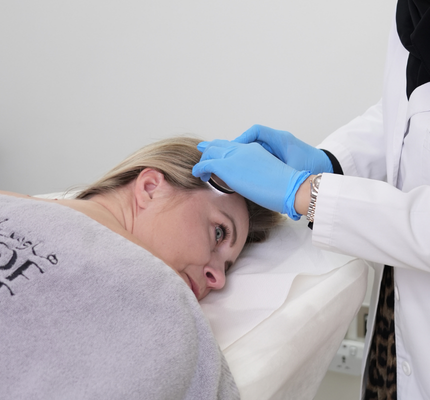
House of Skincare is Yas Island’s specialist dermatology and aesthetic clinic, rated 4.9 stars by over 490 patients. Hair loss has multiple causes and not all respond to the same treatment. Dr. Al Zaabi uses dermoscopy to assess follicle density and activity before recommending Jeisys Density. Androgenetic alopecia, telogen effluvium, and nutritional deficiency all require different management — using LLLT alone without identifying the cause is unlikely to produce lasting results. Dr. Al Zaabi confirms your diagnosis first, then builds a protocol around it.
How Jeisys Density Works
Low-level laser energy at 650–670 nanometres is absorbed by cytochrome c oxidase in the mitochondria of follicular cells. This triggers a photobiomodulation response: ATP production in the follicle increases, cellular metabolism improves, and oxidative stress — a driver of follicular miniaturisation — reduces. The anagen (active growth) phase extends, more follicles are in active growth at any time, and hair shaft diameter improves as follicles recover from miniaturisation.
The mechanism is the same as in Dermalux LED therapy but applied specifically to the scalp and hair follicle layer. The clinical evidence base for LLLT in androgenetic alopecia is robust: multiple randomised controlled trials have demonstrated statistically significant increases in hair count and shaft thickness at 16 to 26 weeks of consistent treatment.
Who Responds Best to Jeisys Density?
Androgenetic alopecia (male and female pattern hair loss): The strongest evidence base. Follicles are miniaturising but still present — LLLT supports their metabolism and slows the progression. Combined with DHT management (finasteride or topical treatments), results are meaningfully better than either treatment alone.
Telogen effluvium: Post-partum shedding, stress-related loss, or loss following illness or crash dieting. LLLT accelerates the return to normal follicle cycling by improving cellular energy in affected follicles.
Diffuse thinning without a diagnosed cause: Some patients show progressive diffuse thinning without classic androgenetic pattern. Dermoscopy identifies whether follicles are miniaturising or absent, and LLLT can support the former.
Hair loss associated with hormonal changes: LLLT supports follicle metabolism independently of the hormonal environment, making it a useful addition to management during menopause or thyroid conditions.
Sessions and Results
The standard course at House of Skincare is two to three sessions per week for sixteen to twenty-six weeks. Each session takes approximately 20 to 30 minutes. There is no discomfort, no heat, no sound — patients sit comfortably under the device. Most notice reduced shedding within six to eight weeks. Measurable increases in hair count and shaft diameter typically become visible at three to six months, and continue to develop through the full course.
LLLT results require consistency. Irregular sessions produce inferior outcomes. Once the initial course is complete, one to two maintenance sessions per week sustain the results by keeping follicle metabolism active. Patients who stop entirely after a course typically return to baseline within twelve to eighteen months as the DHT or hormonal environment continues to work on follicles.
Combining Jeisys Density with Other Hair Loss Treatments
LLLT combined with PRP produces a stronger follicle stimulus than either treatment alone — PRP delivers growth factors to the dermal papilla while LLLT optimises the cellular energy environment in which those growth factors act. Similarly, LLLT combined with minoxidil or DHT-blocking therapy addresses the condition from three distinct biological angles: follicle metabolism, blood flow, and hormonal signal. Dr. Al Zaabi will advise whether a combined protocol is appropriate for your hair loss pattern at consultation.
BENEFITS
- Non-invasive LLLT — no injections, no surgery, no pain or downtime
- Clinically validated: RCTs show increased hair count and shaft thickness at 16–26 weeks
- Extends anagen growth phase and reduces follicular miniaturisation
- Effective for androgenetic alopecia, telogen effluvium, and diffuse thinning
- Combines with PRP and topical treatments for stronger combined results
- DOH-licensed Consultant Dermatologist confirms diagnosis before recommending treatment