
Mesotherapy in Abu Dhabi
$
Mesotherapy in Abu Dhabi
Mesotherapy in Abu Dhabi at House of Skincare delivers a precisely formulated cocktail of vitamins, minerals, amino acids, and hyaluronic acid directly into the dermis and superficial subcutaneous tissue using a series of microinjections. Unlike topical serums that sit on the skin surface, mesotherapy bypasses the epidermal barrier and places active ingredients exactly where collagen synthesis, hydration, and cellular repair occur. Dr. Khadija Al Zaabi, DOH-licensed Consultant Dermatologist at House of Skincare on Yas Island, uses mesotherapy to address a range of skin and scalp concerns, customising the formulation to each patient’s specific presentation.
The term mesotherapy was coined in France in the 1950s to describe intradermal injection of therapeutic substances. The logic is straightforward: active ingredients absorbed through the epidermis must survive enzymatic degradation and dilution in the systemic circulation before reaching the dermis, arriving in concentrations too low for meaningful effect. Direct intradermal delivery deposits them at their site of action at therapeutic concentration. The microinjections themselves also create micro-trauma that activates the skin’s wound-healing cascade, independently stimulating fibroblasts to produce collagen and elastin.
Why House of Skincare?
House of Skincare is a specialist dermatology and aesthetic clinic on Yas Island, rated 4.9 stars by over 490 patients on Google. The effectiveness of mesotherapy depends almost entirely on the quality of the formulation and the precision of the injection technique. Dr. Al Zaabi holds a DOH licence as a Consultant Dermatologist and selects clinical-grade, pharmaceutical-quality mesotherapy cocktails rather than generic blends. The depth of injection, the spacing of needling points, and the volume per injection site are calibrated to each treatment area — face, scalp, and body require different approaches.
What Goes Into a Mesotherapy Cocktail?
Hyaluronic acid (low molecular weight): Low molecular weight HA penetrates the dermis and binds water molecules at a ratio of up to 1000:1, creating deep dermal hydration that plumps the skin from within. It also binds to cell surface receptors and activates fibroblast activity.
Vitamins: Vitamin C (ascorbic acid) is essential for collagen crosslinking and neutralises free radicals generated by UV exposure. B vitamins, particularly B5 (pantothenic acid) and B12, support cellular energy metabolism and wound healing. Vitamin A derivatives support cell turnover.
Minerals and co-factors: Zinc, copper, and silicon are structural and enzymatic co-factors in collagen and elastin synthesis. Copper peptides in particular have been shown to increase collagen and glycosaminoglycan synthesis in fibroblast cultures.
Amino acids: Glycine, proline, and hydroxyproline are the primary amino acids in the collagen triple helix. Delivering them directly to the dermis provides the raw material for new collagen synthesis alongside the stimulus to produce it.
Antioxidants: Glutathione inhibits melanin synthesis in the melanocyte and brightens the overall complexion over a treatment course. It is included in brightening mesotherapy protocols for patients with dull or uneven skin tone.
Face Mesotherapy
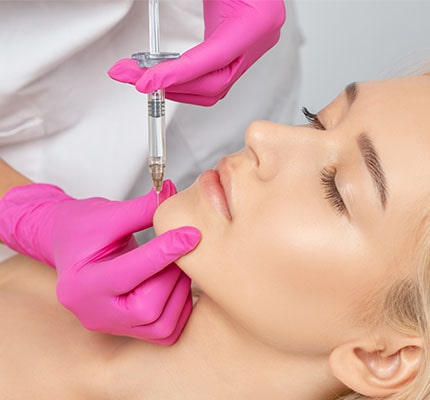
Facial mesotherapy targets dehydration, fine lines, dullness, and early laxity. The injections are placed into the superficial dermis across the face, neck, and décolletage using a fine-gauge needle or a mesotherapy gun for even distribution. The treatment creates a deep hydration effect that is visible within twenty-four to forty-eight hours. Over four to six sessions the cumulative collagen stimulus produces visible improvement in skin firmness and texture. Facial mesotherapy works well as a standalone treatment and as a complement to Profhilo, Botox, or filler treatments.
Scalp Mesotherapy for Hair Loss
Scalp mesotherapy delivers growth factors, hair-specific vitamins (biotin, zinc, B5), minoxidil, and DHT-blocking agents directly into the scalp tissue at the level of the hair follicles. The injections improve follicular microcirculation, provide nutritional support to follicles in the telogen (resting) phase, and create a microenvironment that extends the anagen (growth) phase. Most patients notice a reduction in shedding after two to three sessions, with improved hair density visible after a full course of six sessions. Scalp mesotherapy works for both androgenetic alopecia (pattern hair loss) and telogen effluvium (stress or post-illness shedding).
Body Mesotherapy
Body mesotherapy is used for cellulite reduction and localised fat breakdown. Formulations for body use contain phosphatidylcholine and deoxycholic acid to disrupt fat cell membranes, along with caffeine and L-carnitine to improve lymphatic drainage and fat metabolism. The treatment is most effective on areas of superficial fat with overlying skin irregularity, including the outer thighs, inner arms, and abdomen. Body mesotherapy is a non-surgical adjunct to body contouring, not a weight-loss treatment.
The Procedure
A face or scalp mesotherapy session takes twenty to thirty minutes. The skin is cleansed. A topical numbing cream is applied ten minutes before injection. The formulation is injected in multiple small deposits across the treatment zone using a fine 30 or 32-gauge needle. Most patients experience mild discomfort, comparable to a light pricking sensation. Some redness and pinpoint bleeding at injection sites resolves within two to four hours. There is no significant downtime — most patients resume normal activities the same day, though social activities on the day of treatment may be affected by temporary redness.
Sessions and Results
An initial course of four to six sessions spaced two to three weeks apart produces the most meaningful results. Skin hydration improves within days of the first session. Firmness and texture changes build over the course. After the initial course, monthly maintenance sessions sustain the improvement. Hair loss patients typically complete a six-session scalp course, then move to quarterly maintenance.
Aftercare
Avoid washing the face or scalp for six hours after treatment. Skip strenuous exercise, saunas, and steam rooms for twenty-four hours. Do not apply makeup or irritating products for twelve hours. Use SPF 50 the morning after treatment and daily thereafter. Avoid alcohol for twenty-four hours, as it increases the risk of bruising at injection sites.
BENEFITS
- Delivers vitamins, HA, and growth factors directly into the dermis
- Treats face dehydration, dullness, fine lines, and early laxity
- Scalp mesotherapy reduces hair shedding and improves hair density
- Formulation customised to your skin or scalp concern
- Visible hydration improvement within 24 to 48 hours
- Performed by a DOH-licensed Consultant Dermatologist