
Non-surgical Facelift in Abu Dhabi
$
Non-Surgical Facelift in Abu Dhabi
A non-surgical facelift in Abu Dhabi is not a single treatment. It is a physician-led combination of injectable and energy-based treatments that addresses the three components of facial ageing simultaneously: volume loss, laxity and descent, and skin quality decline. At House of Skincare on Yas Island, Dr. Khadija Al Zaabi, DOH-licensed Consultant Dermatologist with over 21 years of clinical experience, designs each non-surgical facial rejuvenation plan as a unique clinical programme, selecting the specific combination of treatments appropriate for your anatomy, degree of ageing, and treatment goals.
The term non-surgical facelift is used loosely across the aesthetics industry to describe everything from a single filler session to a multi-modality programme. What Dr. Al Zaabi offers is the latter: a structured assessment of what is driving the appearance change in your face, followed by a treatment plan that addresses each contributing factor in the right sequence. This produces a natural, refreshed result rather than the overdone, frozen, or artificial look that results from treating one element in isolation or using too much of any single product.
Why House of Skincare for Non-Surgical Facelift?
Dr. Al Zaabi treats the face as an interconnected anatomical system. A jowl that looks heavy is not just a fat accumulation problem. It is the combined result of bone resorption at the mandible, mid-face volume loss shifting downward, and skin laxity at the lower face. Treating it correctly requires addressing all three contributing factors. Placing filler directly in the jowl area without addressing the mid-face deficiency above it produces a heavy, plugged result that worsens with gravity over time.
The clinic holds a 4.9-star patient rating. All treatments are performed by Dr. Al Zaabi. Product selection, injection plane, energy device settings, and treatment sequencing are physician decisions made at your assessment. The combination that looks natural is the one designed for your specific anatomy, not the most popular combination on social media.
Understanding Facial Ageing
Facial ageing occurs through four simultaneous processes, and effective rejuvenation must address them in the right sequence.
Bone resorption: The facial skeleton loses volume gradually from the third decade. The orbital rim widens, creating the tear trough hollow. The maxilla recedes, reducing mid-face projection. The mandible resorbs, creating mandibular ligament laxity and jowling. Bone-level changes are the deepest structural driver of facial ageing and the most often overlooked.
Fat compartment redistribution: The fat pads of the face are not a single mass. They are distinct anatomical compartments that have different rates of volume loss. The malar fat pad descends as its retaining ligaments loosen. The sub-orbicularis fat (SOOF) thins. The buccal fat pad prolongs its descent to create fullness in the wrong places. Volume replacement must be placed in the correct compartment, at the correct depth, to restore the original anatomy rather than adding volume in an unstructured way.
Soft tissue laxity: The skin and SMAS (superficial musculo-aponeurotic system) descend as retaining ligaments weaken. This produces the nasolabial fold deepening, jowl formation, and midface descent associated with ageing. Laxity is primarily a structural problem and is most effectively addressed with energy-based treatments such as HIFU that work at the SMAS level, not with surface skin tightening.
Skin quality decline: Collagen loss, reduced elastin, accumulated photodamage, and decreased dermal hydration produce the surface changes of ageing: fine lines, dullness, textural irregularity, and a loss of the radiance associated with young skin. Skin quality decline is the most visible layer of ageing but the least structural. Treating it alone without addressing volume and laxity produces a smoothed skin surface that still looks old in shape.
Non-Surgical Facelift Treatments at House of Skincare
Dermal Filler for Structural Volumisation: The foundational element of most non-surgical facelift plans. Juvederm Voluma placed in the mid-face and malar region restores the forward projection and lift that supports the lower face. Juvederm Volux along the mandibular border sharpens the jawline. Chin filler improves the vertical facial proportion and the chin-to-jaw relationship. These are structural placements that change the shape of the face at the bone level rather than simply filling surface lines. When placed correctly, the visual effect is a lift and rejuvenation rather than a fullness. See the Dermal Filler page for full detail on areas and products.
Botox for Dynamic Lines and Muscle Balance: Botulinum toxin addresses the muscle-driven component of facial ageing. The frontalis, glabellar complex, and corrugators drive the upper face lines. The orbicularis oculi drives crow’s feet. The depressor anguli oris pulls the mouth corners down. The masseter, when enlarged, creates a square, heavy lower face. Strategic Botox placement relaxes these muscles where relaxation improves the face and, importantly, leaves others untouched where expression is important. Over-treated Botox produces a frozen, immobile face. Under-treated Botox produces uneven relaxation. The planning of Botox alongside filler determines whether the combined result looks natural.
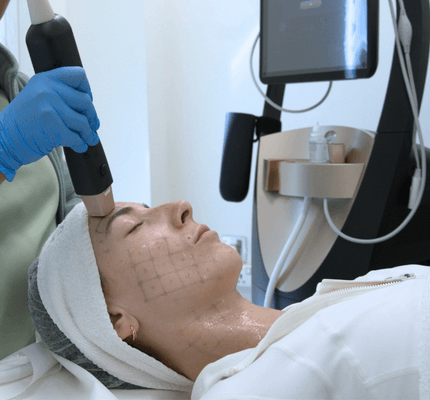
Linear Z HIFU for Structural Lifting: High-intensity focused ultrasound delivers energy to the SMAS layer, the same layer targeted in surgical facelift procedures. The focused ultrasound creates controlled thermal points at 4.5mm depth, stimulating collagen production and causing gradual contraction of the SMAS over 2 to 3 months. The result is a visible lifting of the mid-face and jawline and tightening of the neck. For patients with significant facial descent and laxity, Linear Z HIFU combined with filler and Botox produces results that are significantly superior to any one of these alone. One session produces improvement visible at 2 to 3 months with results lasting 12 to 18 months.
Profhilo for Skin Quality Restoration: Profhilo uses ultra-high-concentration non-crosslinked hyaluronic acid to remodel tissue and improve skin quality from within. It is the skin quality component of a non-surgical facelift programme. Two sessions of Profhilo, delivered via the BAP (bio-aesthetic points) protocol at 4 to 6 week intervals, improve dermal hydration, skin elasticity, and surface radiance, addressing the skin quality layer of ageing that filler and HIFU alone do not reach. The effect compounds over 3 to 6 months and is maintained with twice-yearly treatment sessions.
Sculptra for Diffuse Collagen Restoration: For patients with significant diffuse volume loss across multiple facial zones, Sculptra (poly-L-lactic acid biostimulator) stimulates the patient’s own collagen production over 3 to 6 months. It addresses the deeper structural collagen deficit that drives facial volume loss rather than replacing lost volume directly. The result is a gradual, natural improvement in facial fullness and structural density that looks more natural than filler alone in patients with significant ageing. See the Sculptra page for full detail.
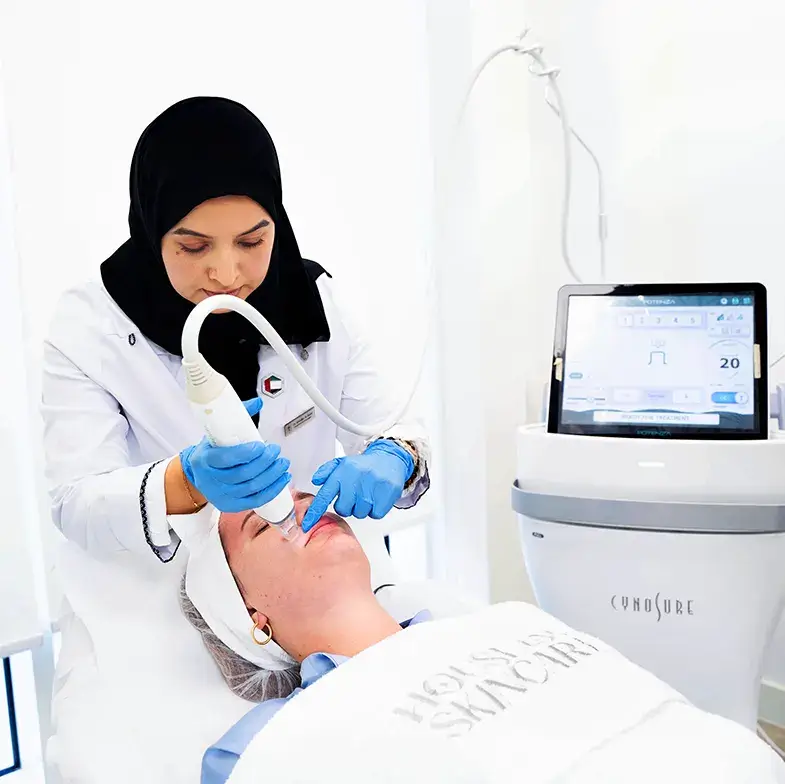
Potenza RF Microneedling for Skin Tightening: For patients with surface skin laxity and textural concerns, Potenza RF microneedling delivers radiofrequency energy into the dermis, stimulating collagen and elastin production and providing a mild to moderate surface tightening effect. It is the skin layer component of the programme for patients with fine lines, early jowl skin laxity, and textural irregularities.
How a Non-Surgical Facelift Programme Is Designed
The first appointment at House of Skincare for a non-surgical facelift enquiry is a full facial assessment and consultation. Dr. Al Zaabi photographs the face from standardised angles, analyses bone structure, fat compartment volume, soft tissue laxity, and skin quality, and identifies which components of ageing are driving the appearance change. She then proposes a treatment plan that addresses each component in the appropriate sequence.
Sequencing matters. Energy-based treatments such as HIFU should not be performed immediately after filler in the same tissue zone, as the thermal energy can degrade the injected HA. Skin quality treatments like Profhilo can be combined in the same session with filler or performed 2 to 4 weeks apart. Botox can be performed at the same visit as filler. The treatment sequence and interval between modalities is as important as the individual treatment choices.
Most non-surgical facelift plans involve an initial intensive phase of 2 to 4 sessions across 3 to 6 months, followed by a maintenance programme of 1 to 2 sessions per year to sustain the results. The face continues to age, so the plan is adjusted at each review appointment based on what has changed.
Who Is a Good Candidate?
Non-surgical facelift is appropriate for patients in their 30s, 40s, and 50s who have noticeable but not severe facial ageing changes and who want a natural improvement without surgery. Patients with very advanced laxity, significant skin excess, or jowling that is primarily driven by fat prolapse rather than ligament laxity achieve better results with surgical facelift and are referred by Dr. Al Zaabi where appropriate.
The best results are achieved in patients who follow through with the full programme including maintenance, who maintain good sun protection habits, and who have realistic expectations about the degree of improvement achievable without surgery.
Alternative and Related Treatments
Lip Filler: Many patients who seek facial rejuvenation also notice volume thinning in the lips. Lip filler is frequently included as a component of a complete facial rejuvenation plan. See the Lip Filler page at House of Skincare for full detail on volume enhancement, shape refinement, and anti-ageing lip treatment.
Carbon Laser Facial: For patients who want regular skin maintenance between the more intensive components of their non-surgical facelift programme, monthly carbon laser facial sessions maintain skin clarity, improve pore appearance, and reduce superficial pigmentation. The treatment is low-downtime and fits easily into a busy schedule.
Skin Booster Injections: Skin booster injectables such as Juvederm Volite or Restylane Skinbooster deliver hyaluronic acid at superficial depth across the face for immediate surface hydration and a luminous skin quality improvement. They are used alongside the structural components of a facelift programme to address the surface skin layer independently. See the Skin Booster page at House of Skincare.
BENEFITS
- Physician-designed treatment plan addressing volume, laxity and skin quality in the correct sequence
- Filler, Botox, Linear Z HIFU, Profhilo and Sculptra available as a combined programme
- Structural placement approach: natural results, not overdone volume addition
- Initial course and long-term maintenance plan provided at consultation
- Full facial photography and analysis at every review appointment
- Performed personally by DOH-licensed Consultant Dermatologist with 21+ years