
PRP Treatment in Abu Dhabi
$
PRP Treatment in Abu Dhabi
PRP treatment in Abu Dhabi at House of Skincare uses your own blood’s healing capacity to stimulate collagen production, accelerate tissue repair, and reactivate hair follicles. Platelet-rich plasma is prepared by drawing a small amount of your blood, processing it in a centrifuge to concentrate the platelets and growth factors, and injecting the resulting plasma into the target area — whether skin, scalp, or joint tissue. Dr. Khadija Al Zaabi, DOH-licensed Consultant Dermatologist at House of Skincare on Yas Island, uses PRP as both a standalone treatment and in combination with microneedling, depending on each patient’s presentation and goals.
Platelets are the blood components that initiate the clotting and wound-healing cascade. They contain a dense reservoir of growth factors, including platelet-derived growth factor (PDGF), transforming growth factor beta (TGF-b), vascular endothelial growth factor (VEGF), and insulin-like growth factor (IGF-1). When platelets are activated at a wound site — or when activated PRP is injected into tissue — they release these factors in a concentrated local burst. The growth factors bind to receptors on fibroblasts and keratinocytes, stimulating collagen synthesis, new blood vessel formation, and cell proliferation. In the scalp, these same signals reach dermal papilla cells and push follicles from the resting (telogen) phase back into the active growth (anagen) phase.
Why House of Skincare?
House of Skincare is a specialist dermatology and aesthetic clinic on Yas Island, rated 4.9 stars by over 490 patients on Google. PRP outcomes depend heavily on the quality of the preparation system. Dr. Al Zaabi holds a DOH licence as a Consultant Dermatologist and uses a validated PRP preparation system that consistently produces high platelet concentration — typically four to six times whole blood baseline. This concentration level is clinically significant: below a threshold of approximately 1 million platelets per microlitre, the growth factor stimulus is insufficient for meaningful tissue response.
PRP for the Face
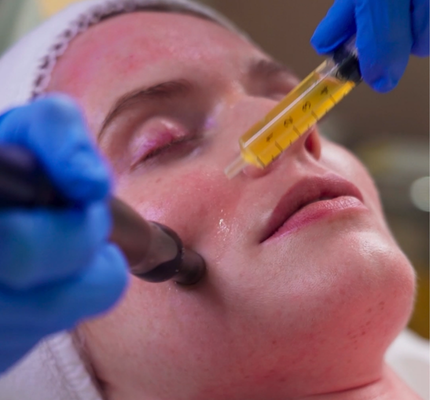
Facial PRP — sometimes called a “vampire facial” when combined with microneedling — rejuvenates the skin by delivering a concentrated growth factor stimulus into the dermis. It is used for fine lines and crepiness around the eyes, general skin quality improvement, dullness from photoageing, and mild laxity in the lower face and neck. The growth factors stimulate fibroblast activity, increasing collagen and elastin synthesis over a course of weeks to months. PRP can be injected directly into the dermis using a fine needle, or applied topically immediately after microneedling to penetrate through the open microchannels.
Results from facial PRP are gradual. The skin improves progressively over eight to twelve weeks following each session as new collagen matures. Most patients complete three monthly sessions and then maintain with quarterly or biannual top-ups.
PRP for Hair Loss
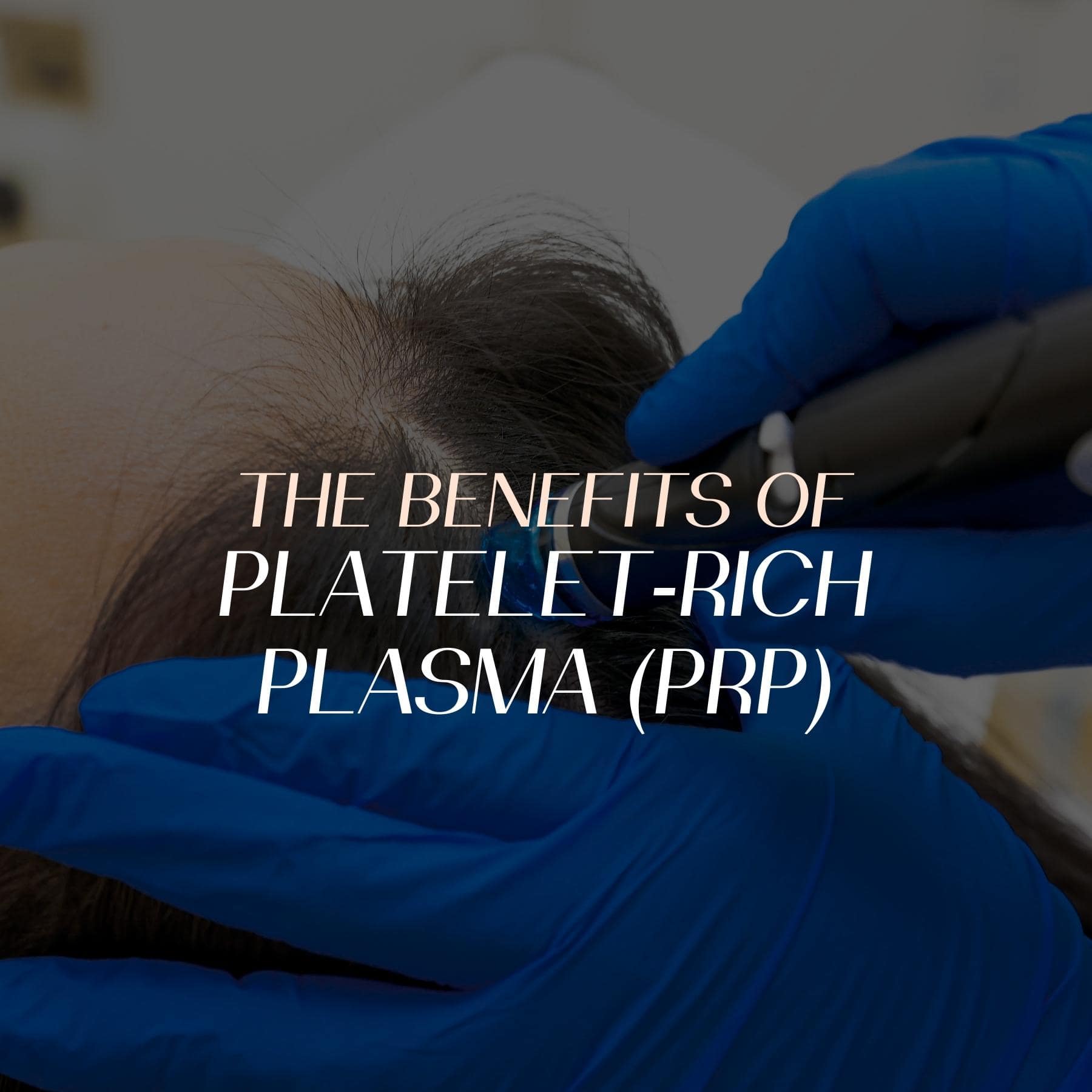
Scalp PRP is one of the most evidence-supported non-surgical treatments for androgenetic alopecia (male and female pattern hair loss) and telogen effluvium. PRP is injected at 1 cm intervals across the affected scalp, targeting the level of the dermal papilla — the structure at the base of each follicle that controls the hair growth cycle. PDGF and IGF-1 from the platelets stimulate proliferation of dermal papilla cells and prolong the anagen phase, resulting in thicker, longer hair shafts and a reduction in miniaturisation.
Most patients notice a reduction in shedding after two to three sessions and visible improvement in hair density after a full course of four to six monthly sessions. Maintenance sessions every four to six months sustain the result. PRP for hair loss works best in the early to moderate stages of hair loss where follicles are still present but miniaturised — it cannot regrow hair in areas where follicles have been completely destroyed by long-standing alopecia.
The Preparation Process
Before each session, a small blood sample of 15 to 30 ml is drawn from a vein in your arm. The blood is placed in a specialised PRP tube and processed in a calibrated centrifuge for eight to ten minutes. Centrifugation separates the blood into its three layers: red blood cells at the bottom, the PRP buffy coat in the middle, and platelet-poor plasma at the top. The buffy coat layer is extracted under sterile conditions. An activating agent (calcium chloride or thrombin) is added to initiate growth factor release just before injection. The entire preparation takes fifteen to twenty minutes and occurs in the clinic immediately before your injection session.
The Procedure
Face and scalp PRP sessions take thirty to forty-five minutes including blood draw and preparation time. For facial PRP, topical numbing cream is applied before intradermal injection. For scalp PRP, a ring block or topical numbing is used depending on the treatment area and patient preference. Injections are placed in a systematic grid across the treatment zone. After scalp PRP, a cold compress is applied for five to ten minutes to reduce swelling and discomfort. Most patients return to work the same day or the following morning.
Results and Sessions
PRP produces gradual, natural results. Skin improvement peaks at eight to twelve weeks after each session. Hair density improvements are measurable at three months, with the full benefit of a treatment course visible at six months. A standard course is three to four sessions at monthly intervals, followed by maintenance every four to six months. Combining scalp PRP with microneedling or low-level laser therapy produces better results than either treatment alone.
Aftercare
After a scalp session, avoid washing the hair for twelve hours. Avoid strenuous exercise, direct sun, saunas, and swimming for twenty-four hours. Do not apply hair products to the scalp for twelve hours. After facial PRP, avoid makeup for twelve hours, use gentle cleansing only, and apply SPF 50 before going outdoors. Avoid NSAIDs (ibuprofen, aspirin) for five days before and after PRP sessions as they inhibit platelet function.
Who Is a Good Candidate?
PRP is suitable for adults in good general health who are not on anticoagulant medications. For hair loss, best results occur in patients in the early to moderate stages of androgenetic alopecia or those with diffuse shedding from telogen effluvium. Patients with very low platelet counts, blood disorders, or active scalp infections are not suitable. Dr. Al Zaabi will review your medical history at consultation before recommending PRP.
BENEFITS
- Uses your own blood — no synthetic additives or foreign materials
- Treats facial fine lines, skin laxity, and photoageing
- Reduces hair shedding and improves hair density in 4 to 6 sessions
- Validated high-concentration PRP preparation system
- Can be combined with microneedling for enhanced results
- Performed by a DOH-licensed Consultant Dermatologist